Summary
- The challenge: District Surveillance officers needed to manually review data to spot whether or not the number of reported cases surpassed a threshold in disease cases, slowing down detection and putting lives at risk.
- The solution: In partnership with Resolve to Save Lives, the Zambia National Public Health Institute created a threshold-based alert system to automatically flag unusual increases in disease cases and prompt timely investigation.
- The impact: The alert system processes data faster and more accurately than manual review, allowing health authorities to find outbreaks faster and stop them sooner.
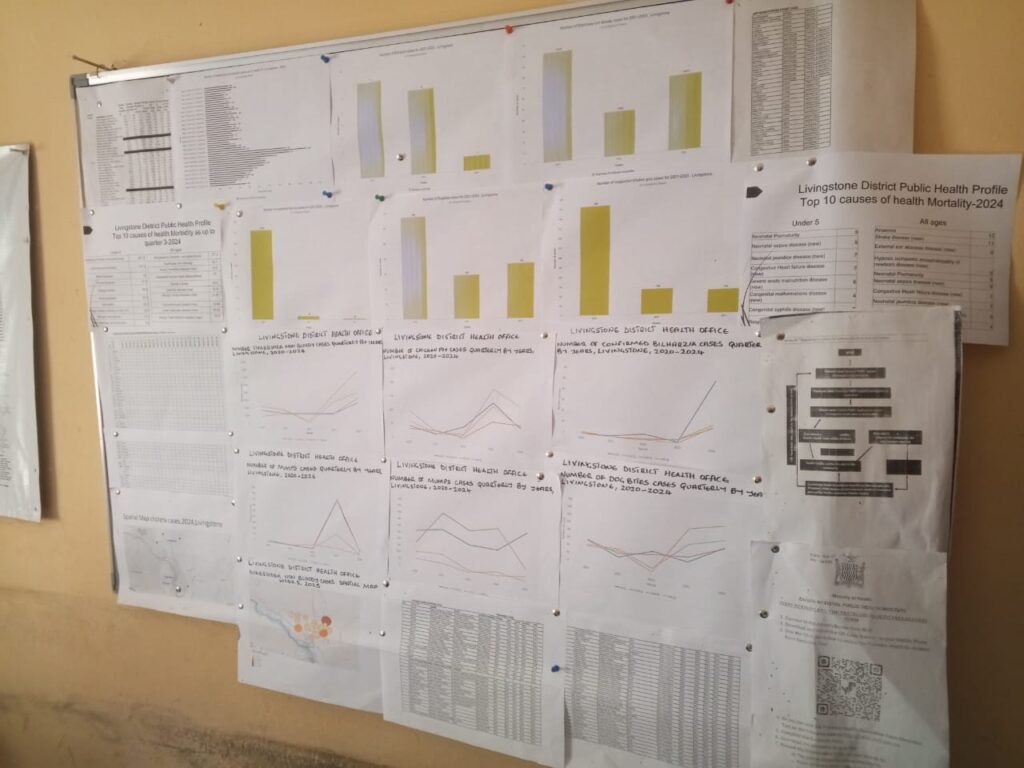
District Surveillance officers needed to manually review data to spot whether or not the number of reported cases surpassed a threshold in disease cases, slowing down detection and putting lives at risk.
How can officials spot early warning signs to stop outbreaks before they spiral into crises?
To prevent isolated disease cases from spiraling into larger outbreaks or epidemics, speed is essential. The Zambia National Public Health Institute (ZNPHI) has long collected weekly data on 34 priority diseases but has until now lacked a way to quickly analyze the large volume of information provided by health facilities across the country. This had also limited Zambia’s ability to fully implement collaborative surveillance, which emphasizes timely and integrated data use across the surveillance system.
A major cholera outbreak in 2023 was one of the most severe in the country’s history, which eventually reached over 20,000 cases and demonstrated the need for faster and more reliable use of surveillance data for early warning and response. In hindsight, ZNPHI noticed that this outbreak was preceded by an unusual rise in suspected cases of non-bloody diarrhea—a known proxy for cholera—but without timely analytical tools, authorities were unable to identify these early warning signs or launch preventive actions that might have reduced the scale of the outbreak.
The solution: A threshold-based alert system
The Zambia National Public Health Institute (ZNPHI) partnered with Resolve to Save Lives (RTSL) to create a threshold-based alert system to analyze weekly disease data and automatically scan for anomalies. Once the number of disease cases surpasses a predefined threshold, it sends an alert to the affected district’s surveillance office, prompting a rapid investigation to determine whether an outbreak may be emerging. The team rolled out the tracker to 26 districts and tested it out from January through December 2025.
“The threshold-based alert system is part of Zambia’s implementation of collaborative surveillance, a strategy that aims to strengthen public health security by integrating data and promoting information exchange at all levels and across sectors” says Dr. Cephas Sialubanje, Director of Strategic Planning and Information Management and Collaborative Surveillance lead at ZNPHI.
Setting the correct thresholds
Determining the right thresholds for the tracker was critical to success. For high-risk, highly transmissible diseases like Ebola, anthrax or yellow fever, just one suspected case is enough to trigger an alert. For others, like cholera or COVID-19, the threshold is less clear.
“There are some conditions where the historical threshold was just an ‘unusual increase’ in cases. So we had to define what that unusual increase should be,” says Steven Nonde at ZNPHI, who helped design the threshold-based alert system. To standardize these thresholds, the team applied two simple rules: an alert is triggered when the caseload doubles over two consecutive weeks or increases one and half times over three weeks. They were then reviewed with district and provincial health officers, who assessed whether the triggers made sense given local disease patterns, and helped validate that they were appropriate for use in their settings. While the thresholds “aren’t foolproof,” Nonde notes, “the purpose is to get surveillance officers to closely interrogate their data. And it’s achieving that.”
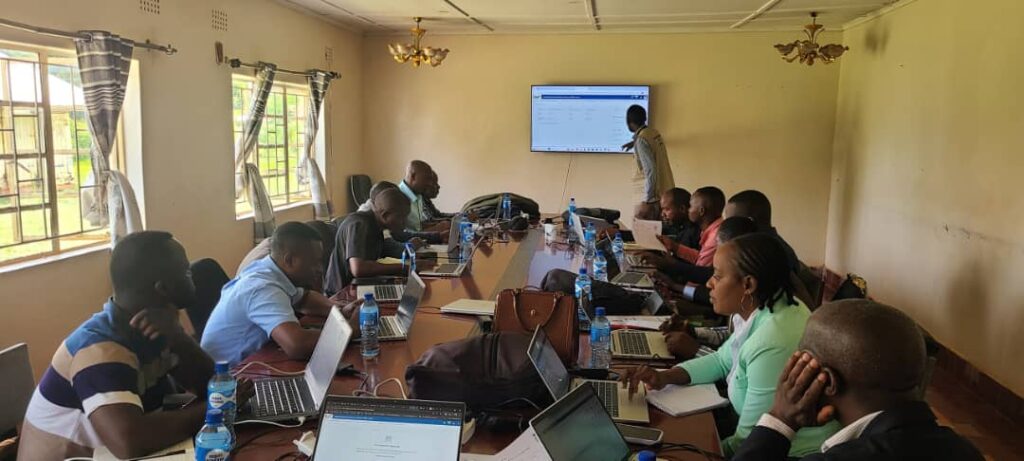
To accompany the tool, the team at ZNPHI also conducted trainings with district surveillance officers to make sure they’re confident using the tool and engaged with senior leadership to secure buy-in and the resources needed for implementation.”
The impact: More High Quality Alerts
Through November 2025, the tool generated 546 alerts across the 26 districts, which ultimately helped to detect 232 events that were investigated and acted on early—interventions that likely prevented outbreaks from taking hold. In Kabwe province, the tool repeatedly flagged increases in cases of non-bloody diarrhea. Each alert was followed by a rise in confirmed cholera cases, demonstrating the system’s ability to predict potential outbreaks. Because alerts were issued early, ZNPHI and district-level teams were able to implement preventive actions, like notifying residents and distributing chlorine to reduce transmission, before caseloads grew out of control.
The system has also improved data quality. Manual threshold calculations and data review are prone to error, especially when analysts are processing huge volumes of information. By automating these calculations and alerts, the system also frees up valuable staff time, allowing public health intelligence officers to focus on verifying alerts and coordinating with district offices rather than processing raw data. The system has also improved visibility of district level events that previously might not have been escalated to ZNPHI, strengthening information flow and integration across different levels of the country’s health system. As a result, the ZNPHI PHEOC now triages all district level events on ZEBRA, its emergency management system, to determine and coordinate the appropriate level of response activities.
Given this initial success, the team has now expanded the program to an additional 44 districts and intends to reach nationwide coverage in 2026. Health authorities across the region, including the Ethiopian Public Health Institute, are learning from this success and considering adopting a similar program.
“Zambia has shown that even a simple, well-designed alert system can transform how quickly countries detect and respond to public health threats,” says Sooyoung Kim, Senior Technical Advisor at Resolve to Save Lives. “The impact we’re seeing so far—faster investigations and better use of data—is exactly what many countries in the region are striving for. Other countries are now looking at Zambia’s experience as a blueprint for how to modernize their own systems, and that kind of regional learning is exactly what collaborative surveillance is all about.