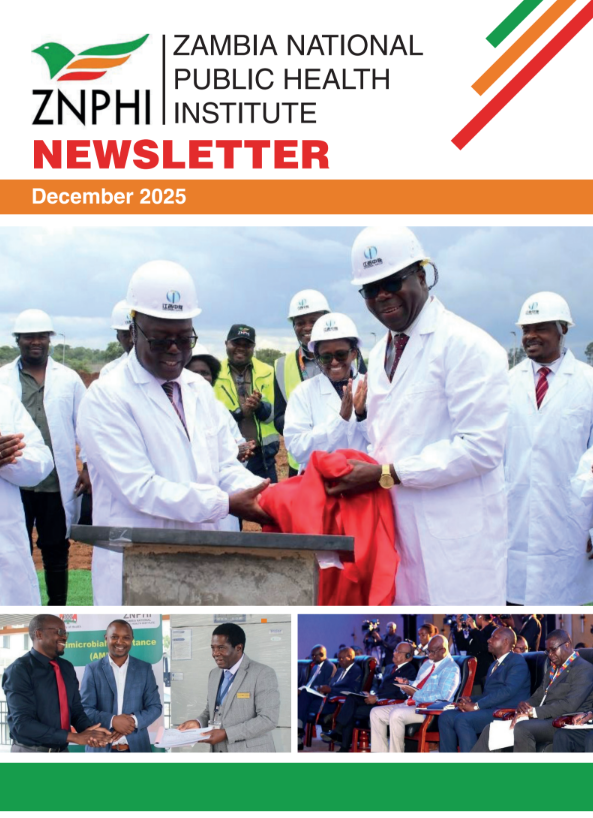
JANUARY 2026 NEWSLETTER
DOWNLOAD JANUARY 2026 NEWSLETTER
JANUARY 2026 NEWSLETTER Read More »

We firmly endorse Tobacco Bill No. 10 of 2022, and here is why.As your institute mandated to address public health security in the country, we cannot keep quiet on tobacco. This proposed Bill amendment brings us close to protecting our communities’ well-being and a critical step toward preserving public health. Tobacco use is still one of the biggest preventable, and indeed totally avoidable causes of mortality and disease on the globe. The World Health Organization (WHO) estimates that tobacco use causes over 8 million fatalities yearly, of which over 7 million are directly related to tobacco use and over 1.2 million are caused by secondhand smoke exposure for non-smokers. Tobacco-related ailments have a detrimental effect on Zambia’s already precarious healthcare system and economy. While there are arguments about the economic contributions of tobacco use, its public health implications are in our view, more important and must be carefully watched and regulated strongly. The bill contains praiseworthy provisions for the regulation of the tobacco industry, which directly or indirectly impact public health. By adhering to the Framework Convention on Tobacco Control (FCTC) of the World Health Organization (WHO), the Bill effectively protects individuals from the harmful effects of tobacco smoking, thereby reducing the severity of the consequences associated with tobacco-related maladies. Furthermore, the legislation aims to enforce a ban on smoking in public areas, thus protecting non-smokers from the detrimental consequences of secondary smoke. Even though Zambia has already implemented a moratorium on smoking in public, enforcement remains lax, thus the bill must be enacted immediately to expand current regulations and strengthen enforcement to increase compliance. With 7% of school-going adolescents involved in cigarette smoking within Zambia, the negative health consequences of excessive tobacco use, especially in young children, pose a serious threat to our future generations. Regulations about the tobacco business may have an impact on the decrease in youth tobacco usage. By enacting measures like licensing requirements, quality standards, and limitations on marketing and sales techniques, the law may make tobacco products less accessible to children and adolescents. Enforcing regulations and encouraging responsible behavior within the tobacco industry are two more ways to stop kids from using tobacco. Supporting the bill represents, in summary, an investment in the long-term health and sustainability of the Zambian people as a whole. Investing in tobacco control measures is not only a sound public health strategy but also an economic imperative. The enormous healthcare costs associated with treating tobacco-related illnesses place a significant burden on healthcare systems and taxpayers. Collectively, we can strive to safeguard lives, mitigate the prevalence of tobacco-related diseases, and establish a setting that harmoniously balances prosperity and well-being. We therefore commend the government’s commitment to prioritizing the well-being of its citizens through the introduction of this vital legislation. Thank you for considering our position on this matter. Should you require any further information or assistance, please do not hesitate to contact us on info@znphi.gov.zm. Prof. Roma Chilengi Director General/Health Advisor to the Republican President
The ZNPHI on tobacco Read More »

The public and stakeholders about whom the New Public Health Order is framed need to know: Coined by the Africa Centre for Disease Control and prevention (Africa CDC), the new public health order is often quoted by countries, Ministries of Health, Institutions and indeed individual technocrats. But what is the new public health order, and what implications does it have on our approach to health security? The Africa Union(AU) Assembly of Heads of State and Government at its 35th Ordinary Session in February 2022 granted Africa CDC operational autonomy. InJuly 2022, AU Assembly, delegating its authority to the AU Executive Council, adopted the revised statute of the Africa CDC. These decisions mean that Africa CDC is now able to handle all its operations and therefore move faster to support any health emergencies; will handle all its administrative, financial, procurement and human resource needs; has authority to declare Public Health Emergency of Continental Security (PHECS); and now has a Committee of Heads of State and Government as the highest decision- making body in its governance. Africa CDC’s vision of a New Public Health Order for Africa constitutes a paradigm shift in Africa’s approach to health security and public health. Briefly, it is hinged on five pillars namely: (1) Strengthened public health institutions at country and continental levels; (2) Strengthened Public Health Workforce; (3) Expanded local manufacturing for health products; (4) Increased domestic resources including financing; and (5) Action-oriented and respectful partnerships based on Africa’s priorities The Africa CDC works with Ministries of health in all member states, and where already established through National Public Health Institutes (NPHI), as is the case for Zambia. According to the Africa CDC the African continent has 23 countries with well-established and functioning NPHI, 19 in the process and 13 not yet decided. Whether a NPHI is established or not in a given country is not the issue; the question is, how resilient is the emergency preparedness and response mechanism? This issue, in most if not all African countries, requires some form of dedicated team of staff working on these because regular Ministry of Health staff are often overstretched with mundane aspects of providing healthcare services to the public. It does require consistent adjustments to streamline surveillance mechanisms, data systems and continuous revies to have a sense of ongoing disease intelligence functions. The public health workforce is another key pillar often misunderstood. Our medical education system was historically designed to make diagnosis and provide appropriate treatment; and indeed, the infrastructure and health sector establishment accordingly aligned. But present-day emergency threats require a rather different approach. This is why the new public health order appropriately urges countries to invest in training and retraining disease detective’s cadre whose orientation is forward looking to anticipate, rather than respond. This requires dedicated training, equipment and appropriate policy framework to support such operations. In future statements, we shall address and justify local manufacturing, domestic resourcing and respectful partnerships. For now, we emphasize that the new public health order is not an optional choice, it is an imperative. We thank the government of Zambia and the Ministry of Health for the steps so far taken in the right direction. Indeed, His Excellency President Hichilema made the point on 16th July 2022 through the Lusaka Declaration when he called on all African leaders to ensure that they have established and functional Public Health Emergency Operations Centers (PHEOCS). Prof. Roma Chilengi Director General/Health Advisor to the Republican President
“SPEAK OUT” – The New Public Health Order Read More »

On August 14, 2024, the World Health Organization (WHO) declared Mpox a Public Health Emergency of International Concern (PHEIC) in accordance with the International Health Regulations (IHR) (article 12) due to its rapid spread in Africa. This followed the Africa Centre for Disease Control and Prevention (ACDC) declaring it a Public Health Emergency of Continental Security on August 13, 2024. The rapid spread of a new virus strain, clade 1b, along with cross-border transmission to previously unaffected countries, necessitated the declaration of the ongoing Mpox outbreak as a PHEIC. A PHEIC is a formal declaration by WHO of an extraordinary event which is determined to constitute a public health risk to other States through the international spread of disease and to potentially require a coordinated international response.This declaration has significant implications, especially for affected and at-risk countries. It will help mobilise specific response resources, including unlocking access to essential funding, and strategic vaccine stockpiles. Additionally, it will prompt international coordination of risk communication and community engagement (RCCE), surveillance, and epidemic response against Mpox. Previous Mpox OutbreaksMpox, an Orthopoxvirus (similar to viruses that cause small pox), was first detected in humans in 1970 in the Democratic Republic of Congo. It is considered endemic to Central and West Africa. However, in recent years, Mpox cases have steadily increased, spreading to countries. The current PHEIC declaration is the second related to Mpox in two years; it was first declared a PHEIC by WHO from July 2022 to May 2023. During that time, 7,146 suspected cases were reported in 2022, and 14,957 cases in 2023. Zambia Remains on High AlertAs of the current declaration, Mpox has affected at least 12 countries, with over 17,000 suspected cases reported in 2024. Of these, 2,863 have been laboratory confirmed and 517 have resulted in deaths. The vast majority of cases, and about 87% of the deaths have occurred in the Democratic Republic of Congo. Fortunately, Zambia has not reported any confirmed cases of Mpox. Despite this, your disease intelligence agency, Zambia National Public Health Institute (ZNPHI), remains vigilant and on high alert. ZNPHI has activated a robust surveillance system that is actively monitoring potential Mpox cases in communities and healthcare facilities. The system is swiftly identifying and responding to any suspected cases. Additionally, a National Contingency Plan for Mpox has been developed, with orientation of staff and enhanced screening at all points of entry, especially at international borders identified as priorities. The country also has diagnostic capacity at the Zambia National Public Health Reference Laboratory. While we await the WHO’s temporary recommendations, safeguarding Zambia from a potential Mpox outbreak requires collective action. We must maintain ‘high alert’ at all levels of our health system and ensure timely and accurate dissemination of information to inform public health actions. Our geographical proximity to DRC with a very long 2,388 kilometer border stretch through which people freely cross, makes us particularly at high risk For further information or assistance, please visit the Ministry of Health or ZNPHI websites and follow their social media platforms. You can also contact ZNPHI via their information lines at 0974 493553, 0953 898941, or 0964 638726. Alternatively, you can call the toll-free line 909 on MTN and Zamtel networks Further reading

The global health landscape is facing unprecedented uncertainty, particularly in external funding. As donor priorities shift and funding landscapes evolve, it’s crucial for countries to reassess their health financing strategies and build resilient systems. For several decades, external funding and assistance have played a critical role in financing lifesaving health interventions across Africa, (and other distressed countries in the developing world) helping to avert millions of deaths. Since 1990, such support has contributed to a 50% reduction in under-five mortality, largely by improving access to vaccines and expanding immunization coverage. Additionally, foreign aid through initiatives like PEPFAR currently supports 20 million people living with HIV—including over 500,000 children in 55 countries, most of them in Africa—to receive life-saving antiretroviral treatment.1 However, recent shifts in the global health financing landscape threaten to reverse these gains. The United States Government’s recent decision to withdraw from the World Health Organization, along with executive orders to review foreign aid spending will potentially reshape global health financing. As the world’s leading donor, any significant reduction in U.S. external aid certainly will send shockwaves throughout the global health ecosystem. It is important to note, however, that development assistance for global health was already on the decline even before the United States’ executive orders. In recent years, official development aid to Africa has gradually decreased. Globally, health funding dropped from around $84 billion in 2021—driven largely by the COVID-19 response—to about $66.4 billion in 2023, only slightly above pre-pandemic levels. During the same period, while U.S. funding remained relatively stable, contributions from other countries fell sharply from $64.9 billion in 2021 to $44 billion in 2023 (See figures 1 and 2).1 The decline in external funding is expected to create significant gaps in health financing, placing already fragile health systems under immense strain. This financial downturn comes at a time when disease outbreaks are on the rise. Since 2022, the Africa CDC has recorded a 40% increase in public health emergencies on the continent.2 Figure 1 Total global health funding and funding from other countries except the United States from 2013 – 2023.3 Figure 2 Total global health funding against funding from the United States from 2013 – 2023.3 Within the same period, two Public Health Emergencies of International Concern (PHEICs) have been declared—both linked to the high transmission of Mpox. The recent emergence of Marburg virus in East and Central Africa is raising concerns about the resurgence of viral hemorrhagic fevers. Africa’s dependence on imported medical products such as drugs.2 Diagnostics and vaccines, is another major cause for concern. For instance, Africa manufactures less than 1% of the global vaccine stockpile yet consumes 12% of global vaccines. Consumerism tendency of Africa without a basis for capacity to pay is a dangerous state which we must begin to redress. Although the full extent of how disruptions to external funding will impact health systems remains uncertain, reductions in support for HIV programmes are expected to have devastating consequences, if left unaddressed. UNAIDS estimates that if PEPFAR were halted, an additional 6.3 million AIDS-related deaths could occur.1 Zambia, like many other countries, would experience a seismic shock to its health system if external funding were to decline significantly. The country remains heavily dependent on donor support. In 2022, both the Zambian government and external donors each accounted for 41.4% of total health expenditure. The remaining funding came from social health insurance (6.3%), out-of-pocket payments (9.7%), private health insurance (0.1%), and other NGO sources (1.1%).3 An opportunity to rethink health financing: While the prospect of declining external support may seem daunting, it also presents an opportunity to rethink how we finance health and sustain public health security. Rather than viewing this as a setback, we can use it as a catalyst to build more resilient and sustainable health financing. To attain this, we must think of the adjustments needed to turn what only appears as a challenge into an opportunity. The following are key actions we can consider as we move a new path forward: 1 Leverage global and regional collaborations: We must embrace multilateralism and partnerships, especially in the face of rising unilateral decision-making. Infectious diseases do not recognize national borders, and their health and economic impacts often spill over into neighbouring countries and regions. This makes cross-country collaboration and strong multilateral engagement not just beneficial, but essential. During the COVID-19 pandemic, multilateral agreements on vaccine access were instrumental in mitigating global disparities.4 One such forward-looking initiative is the proposed WHO Pandemic Agreement, which seeks to strengthen global preparedness and response to future pandemics of similar magnitude. The Pandemic Agreement will also prioritise sharing of information between countries including genomic sequencing of pathogen.4 Similarly, the Africa CDC is championing the establishment of the Africa Epidemics Fund—a pooled resource to support emergency preparedness and rapid response. It is also proposing innovative mechanisms such as regional solidarity levies, including an airline tax, to mobilize additional funding.2 Countries across the continent should rally behind such initiatives; and indeed, pick up cues and domesticate some of the practical options. For example, a $50 additional levy of flights could result in $50 million when a million persons fly. 2. Prioritise high impact, evidence informed interventions: Now more than ever, it is crucial that public health spending is guided by the best available evidence. This entails building local expertise in health financing to inform resource allocation and support difficult trade-off decisions when resources are limited. It also calls for strengthening—and, where necessary, establishing—health economics, research, and policy units that can bridge the gap between evidence and policymaking.5 This should transcend across all levels. At point of implementation, officers should ensure programmes undertaken represent value to all stakeholders. This for Zambia must include reduction of unnecessary “workshop meetings”, reduction of travel to only essential trips. 3. Exploring new and innovative financing models: It is abundantly clear that countries must increasingly tap into domestic resources to sustain and advance public health security, particularly in the wake of a steep decline in external support. Strengthening domestic commitment is vital to protect health systems from the